Revision Knee Replacement: Why It’s More Complex Than a First-Time Surgery
Published by Dr Oliver Khoo at Monday, December 1, 2025


Revision knee replacement is a procedure performed when an existing knee implant fails or no longer functions as intended. While primary knee replacement is already a major surgery, a revision procedure is significantly more complex. It requires advanced surgical planning, specialised implants, and careful management of complications caused by previous surgeries.
Understanding why revision surgery is more challenging helps patients set realistic expectations around recovery, outcomes, and ongoing knee health.
A knee replacement is designed to last many years, but various factors can lead to implant failure or deterioration. Common causes include:
Over time, the materials in a knee implant—typically metal, polyethylene, or ceramic—can wear down. This process may lead to the implant loosening from the bone, causing pain, instability, and reduced function.
Infection is one of the most serious complications of joint replacement surgery. Even many years after the initial procedure, a deep infection around the implant can occur and often requires removal of the prosthesis and a staged revision.
Ligament imbalance, implant malalignment, or trauma can cause instability. When the knee feels like it is giving way or shifting, revision surgery might be necessary to correct the soft tissue or bony structure.
Some patients develop significant stiffness that affects mobility. If non-surgical treatments fail, surgeons may recommend a revision to improve knee motion.
Bone fractures near the implant—known as periprosthetic fractures—require complex reconstruction and may involve revision components.
Although rare, implants can fracture or fail, especially if they have been in place for decades or if there is significant bone loss.
Revision knee surgery is notably more complicated than first-time knee replacement due to several unique challenges:
Previous surgery changes the normal structure of the knee. Scar tissue develops, soft tissues may be weaker, and landmarks the surgeon relies on for accurate placement are less clear.
One of the biggest challenges is managing bone loss caused by implant loosening, infection, or the removal of the original prosthesis. Loss of bone stock often requires reconstruction using grafts or specialised implants.
Extracting an old implant can be difficult, especially if it has grown into the bone. The process must be done carefully to avoid further damage to surrounding bone and tissue.
Revision surgeries take longer and carry increased risks, including infection, blood loss, and complications during recovery. Patients often require additional postoperative support.
Because of the complexity, revision knee replacement is typically performed by surgeons with advanced training in reconstruction and experience managing difficult situations.
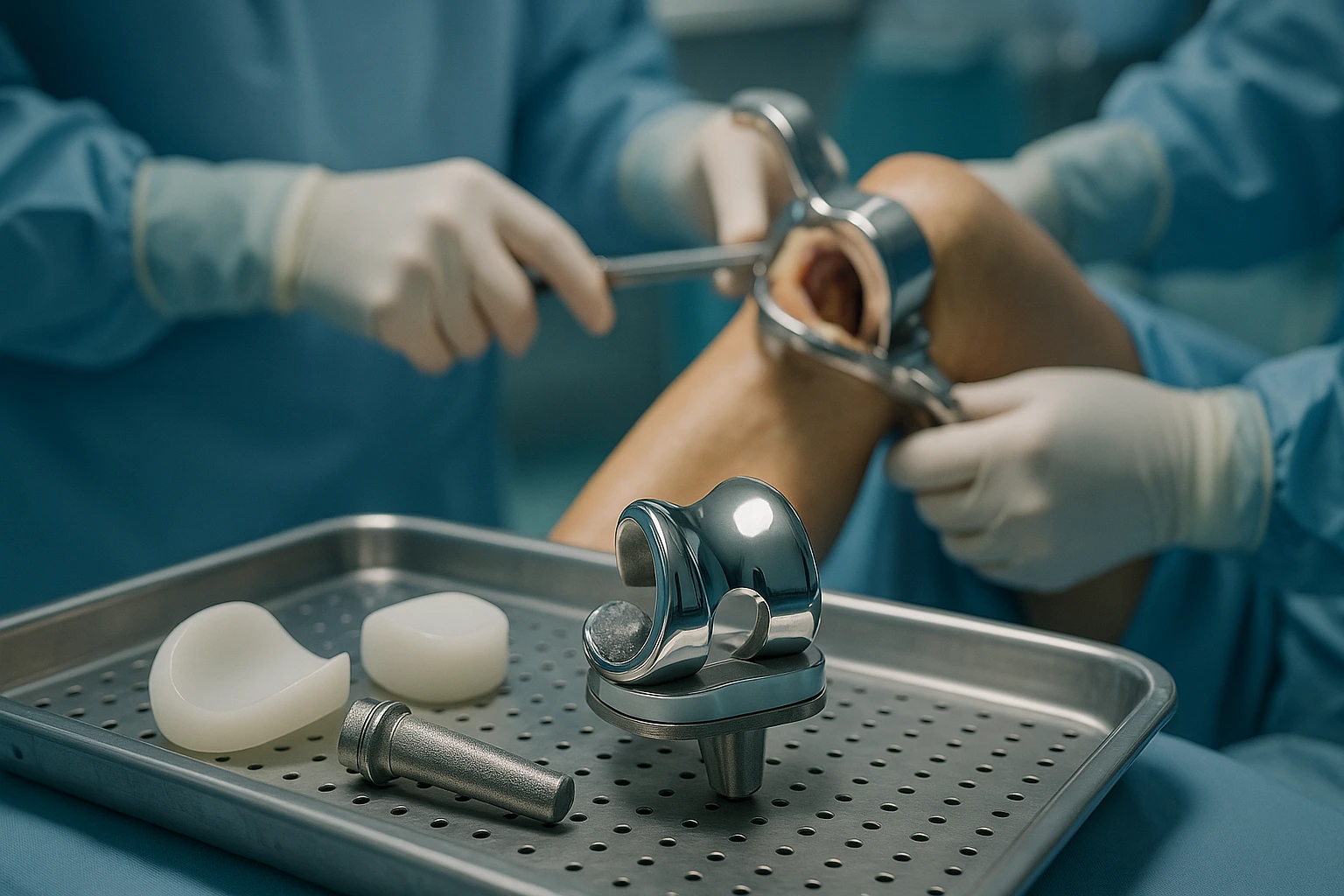
Revision surgeries use a different set of implants than primary knee replacements. These components are designed to provide additional stability and compensate for bone or ligament deficiencies.
Instead of a table, here is a clear list of commonly used revision implant types:
Stems extend deeper into the bone, adding extra support and improving fixation when the normal bone surface is compromised.
These components offer enhanced stability when the knee ligaments are weak or imbalanced.
Used in severe cases of instability or bone loss, hinged implants allow controlled motion and provide strong structural support.
Metal augments or porous metal cones help rebuild areas where bone has been lost, allowing the implant to fit securely.
For highly complex cases, custom-made implants may be recommended to match a patient’s unique anatomy.
Your surgeon chooses the implant based on factors such as bone quality, the reason for revision, ligament function, and overall knee stability.
While revision surgery aims to restore function and reduce pain, outcomes can differ from an initial knee replacement. Here’s what patients should expect:
Recovery generally takes longer due to more extensive surgical work. Some patients may require assistive devices for a longer period.
Due to factors such as scar tissue and altered anatomy, risks like infection, blood clots, or persistent stiffness may be slightly higher.
Despite added complexity, most patients experience meaningful improvements in pain relief, stability, and mobility.
Modern revision implants are built for durability, but longevity depends on bone health, patient activity levels, and the extent of reconstruction required.
Targeted physiotherapy plays a crucial role in regaining strength, balance, and range of motion after a revision procedure.
Signs include increased pain, swelling, instability, stiffness, or reduced mobility. New clicking or grinding sensations may also indicate a problem. Diagnostic imaging and a surgical assessment are required to confirm implant failure.
Patients may experience a similar pattern of postoperative pain, though recovery can feel slower due to the complexity of the procedure. Pain is manageable with modern techniques and medication plans.
Most can, but suitability depends on general health, bone quality, and the severity of the issue. High-risk patients may require staged or modified approaches.
A revision implant can last 10–20 years or more, depending on several factors such as activity level, implant type, and whether major bone reconstruction was required.
Many patients achieve major improvements, especially if the revision corrects instability or loosening. However, results vary based on preoperative condition, bone loss, and healing.
Delaying revision can lead to worsening bone loss, increasing pain, and decreased stability. In cases of infection, delaying treatment may cause serious systemic complications.
Most revisions are single-stage. However, if infection is present, a two-stage approach (removal, spacer, then re-implant) is often recommended.