Robotic Knee Replacement: What It Actually Improves (and What It Doesn’t)
Published by Dr Oliver Khoo at Monday, January 5, 2026


Robotic-assisted knee replacement is often presented as the next big leap in orthopaedic surgery. Patients are told it’s more precise, more personalised, and capable of delivering faster recovery and better long-term outcomes. While there is truth behind many of these claims, robotic knee replacement is not a magic solution — and understanding its real benefits (and limitations) is essential before making decisions about surgery.
This article breaks down what robotic knee replacement genuinely improves, where expectations need to be realistic, and some of the most common myths surrounding the technology.
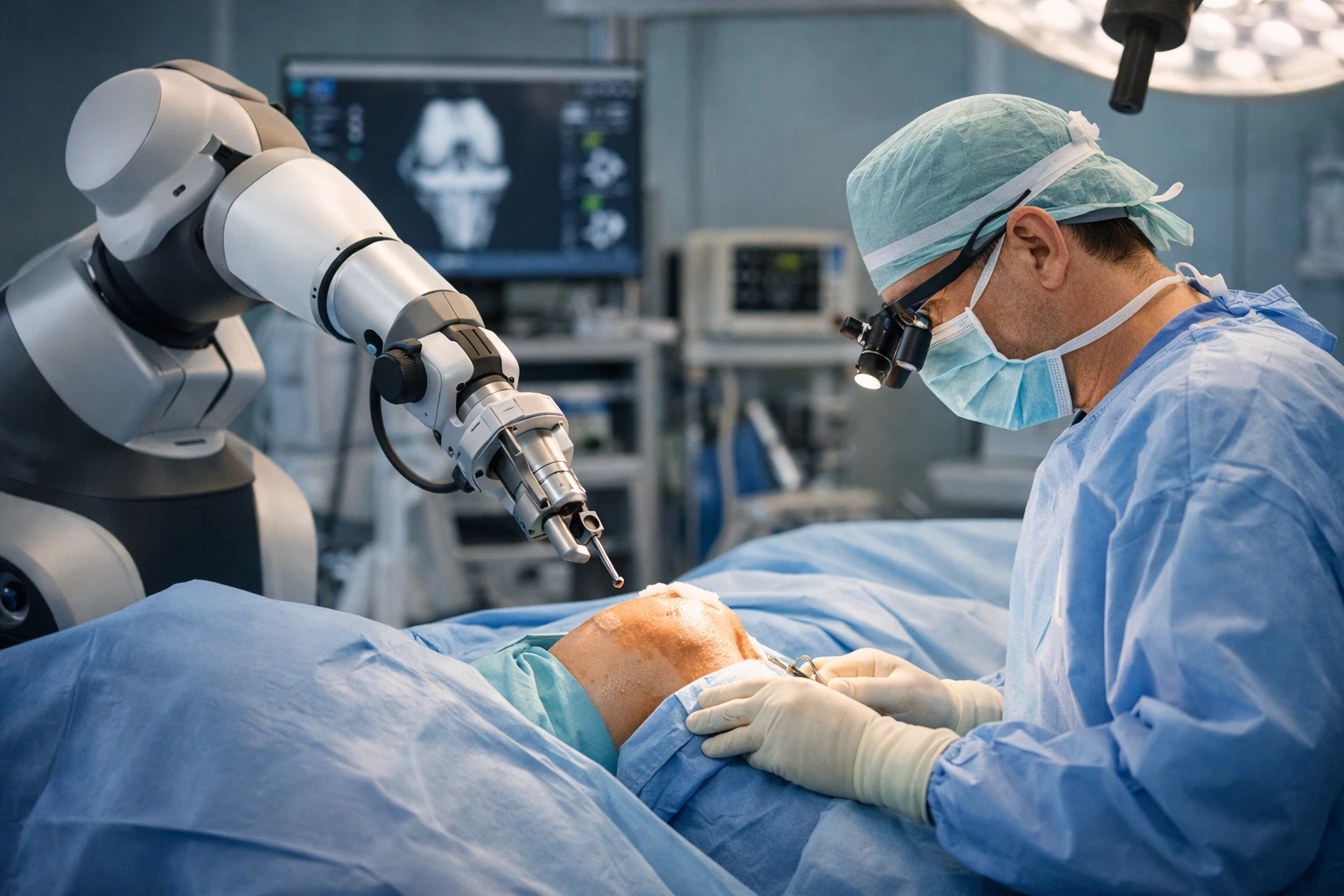
Robotic knee replacement is not a surgery performed by a robot alone. The surgeon remains fully in control throughout the procedure. The robotic system acts as a highly advanced tool that assists with planning, precision, and execution.
Before surgery, a detailed digital model of the patient’s knee is created, often using imaging or intra-operative mapping. During the operation, the robotic system helps guide bone cuts and implant placement based on this individual anatomy, while the surgeon makes all final decisions.
One of the strongest advantages of robotic assistance is improved accuracy.
Robotic systems help the surgeon:
This level of precision is difficult to achieve consistently with manual instruments alone, particularly in complex knee anatomy.
Correct alignment of the knee implant plays a significant role in how the joint feels and functions after surgery.
Robotic assistance can:
Better alignment may contribute to improved joint stability and more natural movement, especially during walking and standing.
Balancing the ligaments around the knee is one of the most challenging aspects of knee replacement surgery.
Robotic systems allow surgeons to:
This can result in a knee that feels more stable and predictable after surgery.
Traditional knee replacement relies heavily on the surgeon’s experience and manual technique. Robotic systems help reduce variability by providing measurable data and repeatable accuracy.
This consistency can be particularly beneficial in:
While robotic technology offers real benefits, it does not eliminate all challenges associated with knee replacement surgery.
A common misconception is that robotic knee replacement automatically leads to faster recovery.
In reality:
Some patients recover quickly, others take longer — robotic assistance does not override the body’s natural healing process.
Robotic technology does not remove post-operative discomfort.
Patients should expect:
Robotics may reduce soft tissue trauma in some cases, but surgery is still surgery.
While accurate alignment may help implants last longer, robotic surgery does not guarantee a longer-lasting knee replacement.
Longevity still depends on:
Robotics may reduce certain risks, but it cannot prevent wear entirely.
Robotic systems enhance a surgeon’s ability — they do not replace expertise.
Outcomes remain strongly influenced by:
A skilled surgeon using robotic assistance is very different from relying on technology alone.
Recovery differences between robotic and traditional knee replacement tend to be subtle rather than dramatic.
Some patients report:
However:
The key difference lies more in consistency than speed.
False. The surgeon performs the surgery. The robot assists with guidance and precision.
Not necessarily. In straightforward cases, traditional surgery can still deliver excellent results.
Recovery varies. Robotics may help in some areas, but it does not guarantee rapid healing.
No surgery is risk-free. Robotic assistance reduces certain technical risks but cannot remove all complications.
Robotic knee replacement may be particularly beneficial for:
It may be less critical for:
The best approach is an informed discussion with your surgeon about what suits your specific situation.
Is robotic knee replacement safer than traditional surgery?
Robotic assistance can improve precision and reduce certain technical errors, but overall safety still depends on surgical expertise and patient health.
Does robotic surgery reduce hospital stay?
Some patients may leave hospital slightly earlier, but length of stay is influenced by pain control, mobility, and individual recovery.
Will I feel the difference in my knee?
Some patients report a more natural-feeling knee, particularly in balance and stability, but experiences vary.
Is robotic knee replacement more expensive?
Costs vary depending on hospital and system used. Not all additional costs are passed directly to patients.
How long does a robotic knee replacement last?
Longevity is similar to traditional knee replacements and depends on lifestyle, weight, and activity rather than robotics alone.
Robotic knee replacement is a powerful tool that enhances accuracy, alignment, and consistency. It does not replace surgical expertise, eliminate pain, or guarantee faster recovery — but when used appropriately, it can meaningfully improve certain aspects of knee replacement surgery.
Understanding what the technology truly offers helps patients make confident, informed decisions without unrealistic expectations.